Project · CJ
A studio monitor system, designed with an AI
I designed a four-way active studio monitor system — a fleet of them — in collaboration with an AI, from acoustic first principles through CNC-ready fabrication files. The interesting part isn't the speakers. It's that every dimension lives in code, every joint was verified computationally in assembled coordinates, and the design survived five adversarial reviews before a single sheet of Baltic birch was cut. Twelve revisions, A through L. The final reviewer is a measurement microphone, because it's the only one without priors.
Why this belongs here
I spend my working life on AI adoption, governance, and the question of when AI output can be trusted for consequential decisions. This project is that question in miniature, with a falsifiable ending: either the boxes fit or they don't.
The disciplines that made it work — executable artifacts instead of prose, adversarial review, domain-specific personas, verification gates, revision control — are the same ones I argue for in enterprise AI deployment. Here they're legible, because the domain is plywood.
It's called CJ, because he has a sweet sound.
The system
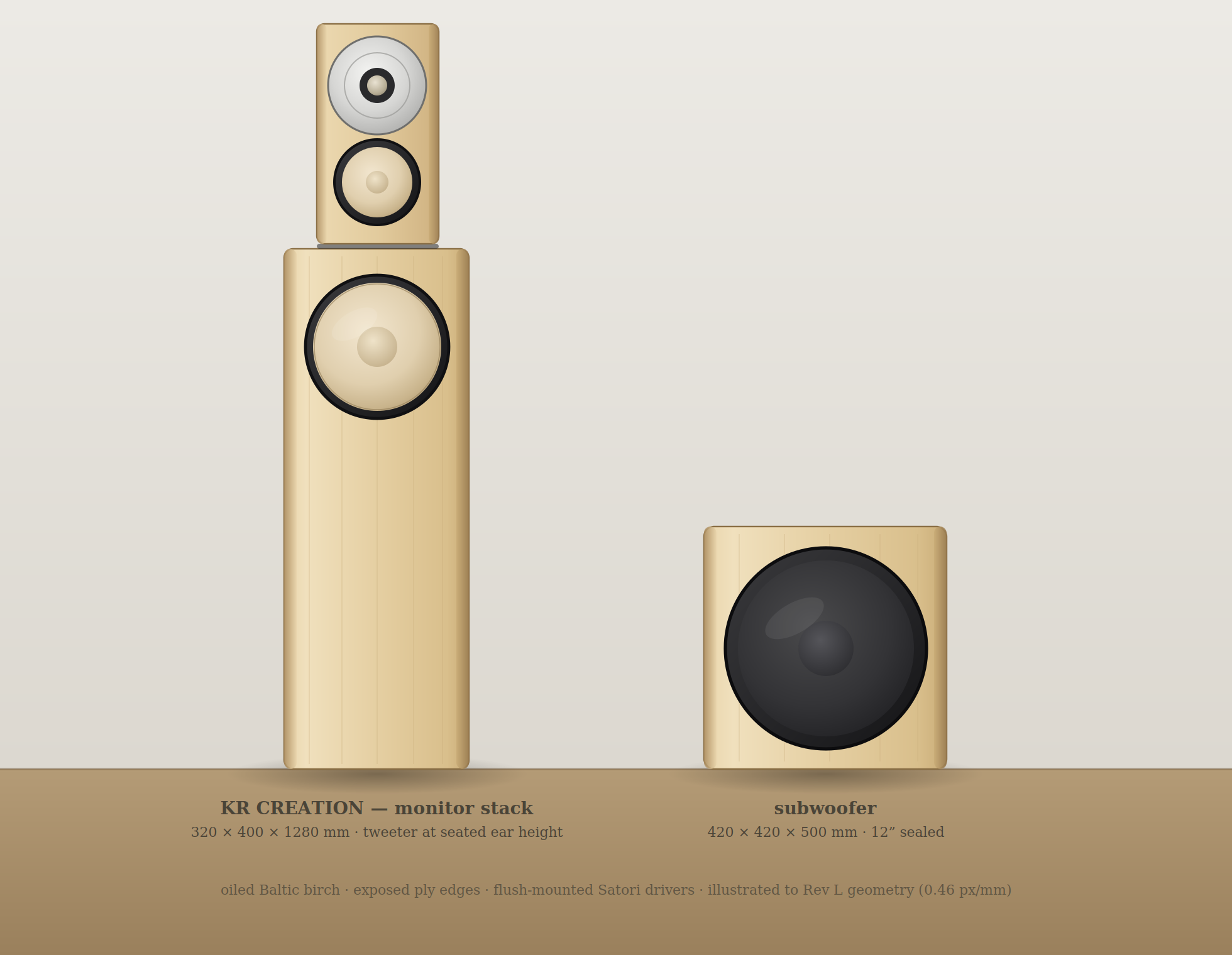
- Architecture 4-way active, split design — the bass cabinet doubles as the stand, with a separate midrange and tweeter head, plus a companion 12″ subwoofer.
- Bands Sub below 80 Hz · woofer 80–250 · mid 250–2k · tweeter above 2k. All LR4, in DSP.
- Drivers Satori WO24P-4 (9.5″), MR13P-4 (5″) and TW29BNWG-4 beryllium waveguide tweeter; SB Acoustics SB34SWPL76-4 (12″) in the sub. All sealed alignments, no ports.
- Amplification Hypex FusionAmp plate amps — FA123 three-channel, FA501 for the subs. Crossover, amplification and limiters in one module per cabinet, so a single AES3 cable chains a whole room.
- Construction 18mm Baltic birch, CNC flat-pack with dado and blind locking-tab joinery, so the boxes self-square during glue-up. Laminated 36mm baffles, exposed ply edges, hardwax oil.
- Stack 320 × 400 × 1280 mm, putting the tweeter at seated ear height, roughly 1178 mm.
The hardware
Every part is off the shelf. There is no passive crossover anywhere in the system — the Hypex modules hold the crossover, the amplification and the limiters together, one module per cabinet.
- SB Acoustics Satori WO24P-4 In the bass cabinet, sealed, no port.
- SB Acoustics Satori MR13P-4 In the head unit, alongside the tweeter.
- SB Acoustics Satori TW29BNWG-4 Beryllium dome in an aluminium waveguide.
- SB Acoustics SB34SWPL76-4 In the companion sealed cabinet.
- Hypex FusionAmp FA123 Drives the woofer, midrange and tweeter, and holds the LR4 crossover in DSP. One AES3 cable chains a whole room.
- Hypex FusionAmp FA501 One per subwoofer cabinet.
The documents
Everything needed to understand or rebuild the design. All three are outputs of the same programmatic source, so the geometry agrees across them by construction.
- System blueprints Build scope, the four-way DSP acoustic targets, enclosure alignments and driver assignments per cabinet.
- Fabrication package The CNC scope of work: 52 plywood panels per system, panel profiles with locking tabs, rabbets, dados and blind pockets, plus material and tolerance requirements.
- Assembly guide Parts list per system, panel identification with holes drawn as machined, hardware schedule and glue-up sequence.
Status
Design frozen at Rev L and verified. It is not built: requests for quote are out to CNC shops around Atlanta, and one prototype set will be cut, assembled and measured before anything else is made.
A build log and the measured results will follow — including whether the predictions hold.